Forced to Serve
in the North End
(awaiting installation)
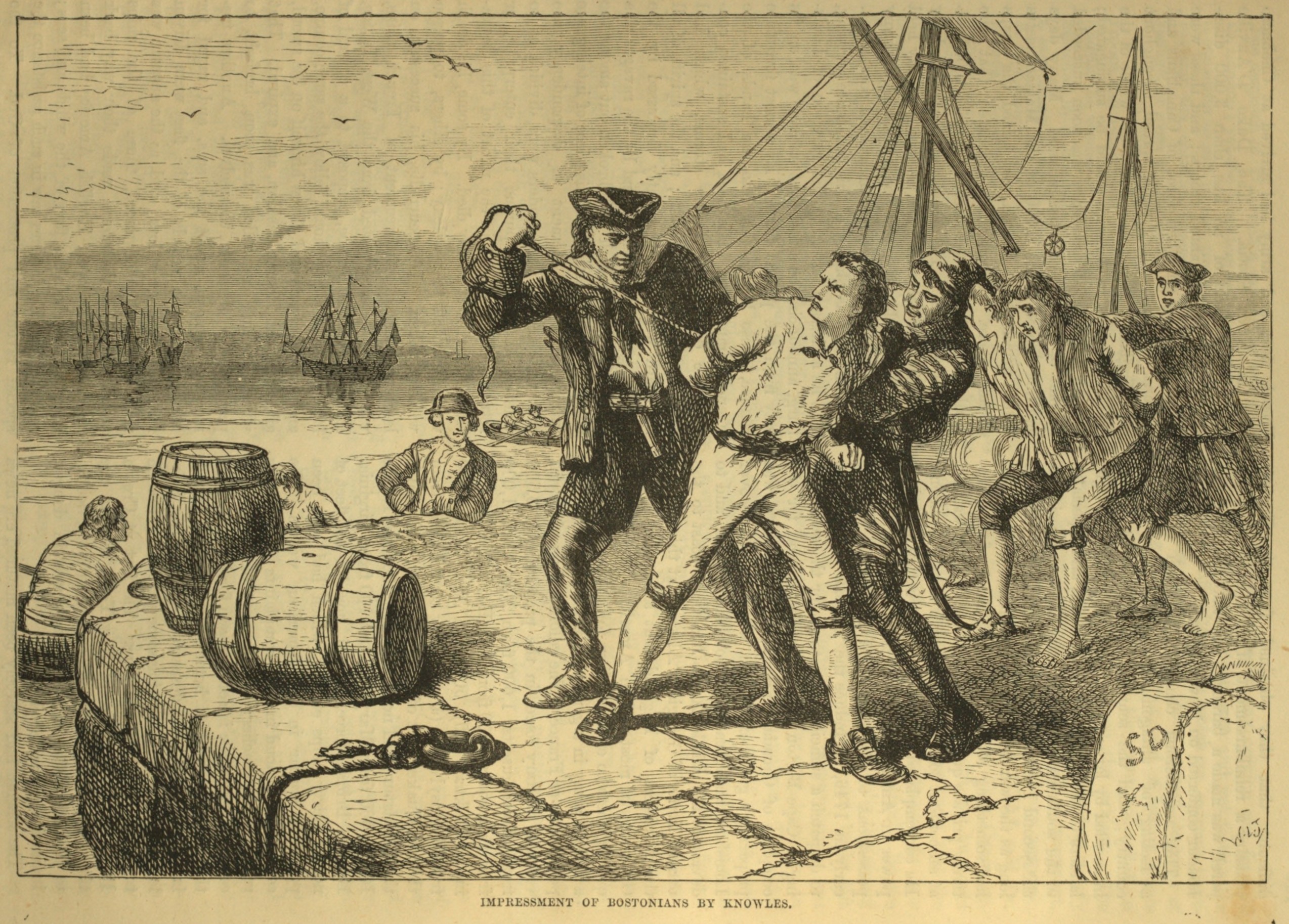
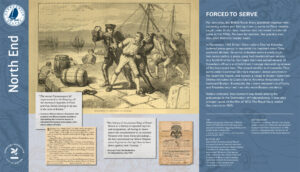
British press-gangs seized men in Boston Harbor off ships set to sail and reportedly along the waterfront, triggering what became known as the Knowles Riot.
Illustration from Cassell’s History of the United States by Edmond Ollier, 1874-77
For centuries, the British Royal Navy practiced impressment—capturing sailors and forcing them to serve on Navy vessels. Legal under British law, impressment increased in colonial ports in the 1740s. Perilous for seamen, the practice also disrupted Boston’s coastal trade.
In November 1747, British Commodore Charles Knowles, ordered press-gangs to replenish his depleted crew. They captured 46 men. Tensions in Boston were already high; two years earlier, a press-gang had murdered two sailors in a North End home. Outraged mariners seized several of Knowles’s officers and held them hostage demanding release of the impressed men. The crowd swelled to thousands. They surrounded Governor Shirley’s mansion, broke windows in the assembly house, and burned a barge in Boston Common. Shirley retreated to Castle Island. Knowles threatened to bombard Boston. Eventually the rioters released the officers, and Knowles returned men who were Boston residents.
Widely detested, impressment was listed among the grievances in the Declaration of Independence. It was also a major cause of the War of 1812. The Royal Navy ended the practice in 1815.
“The worse Consequence [of impressment] is the Keeping off the necessary Supplies of Food and Fuel [from] coming in by sea to the town of Boston,”
— Governor William Shirley’s November 1742 appeal to the Massachusetts legislature highlighting the economic impact of impressment because press-gangs were taking sailors off ships.
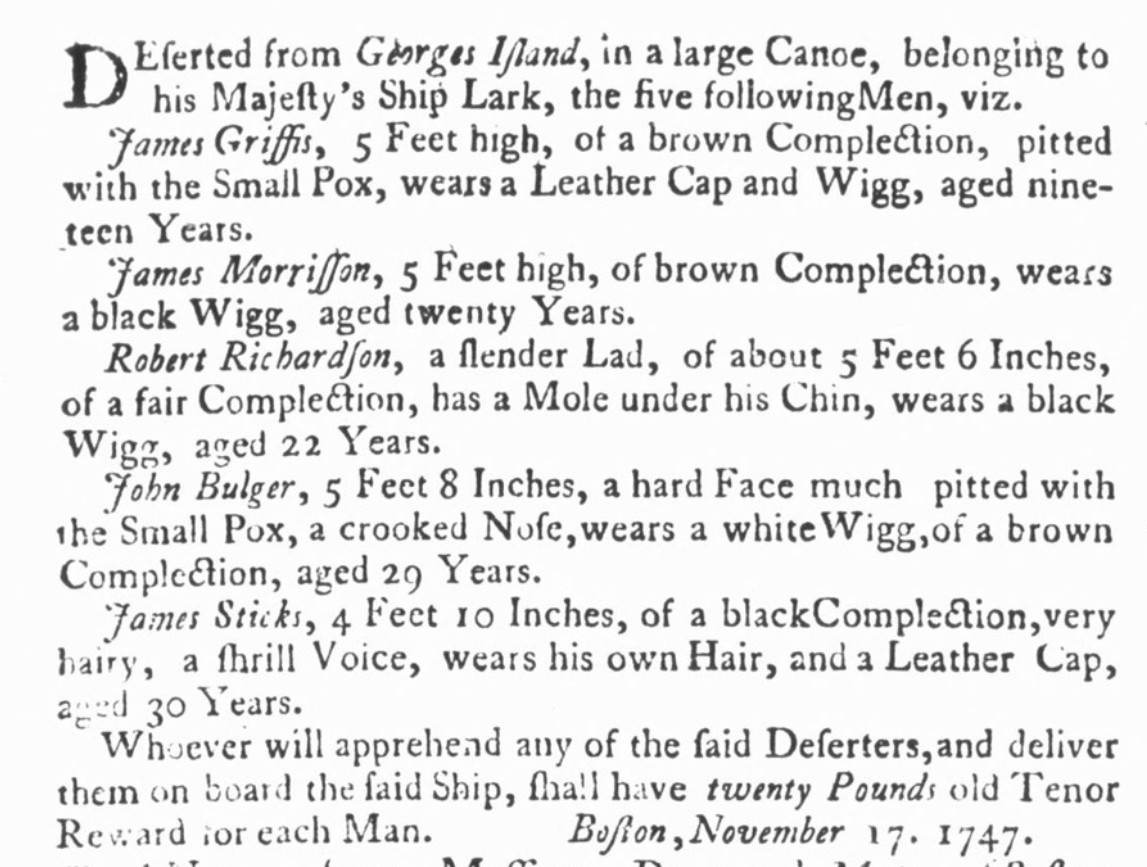
Commodore Knowles placed this ad for several of the 50 men who deserted from his ships anchored in Boston Harbor. Conditions for Royal Navy sailors were brutal. Moreover, they served until a particular war ended, they died, or deserted. Many chose to escape, especially in North American ports. The result: more impressment.
Boston Gazette, November 17, 1747
“The history of the present King of Great Britain is a history of repeated injuries and usurpations, all having in direct object the establishment of an absolute Tyranny over these States [including]… He has constrained our fellow Citizens taken Captive on the high Seas to bear Arms against their Country…”
— Excerpt from the Declaration of Independence, July 1776
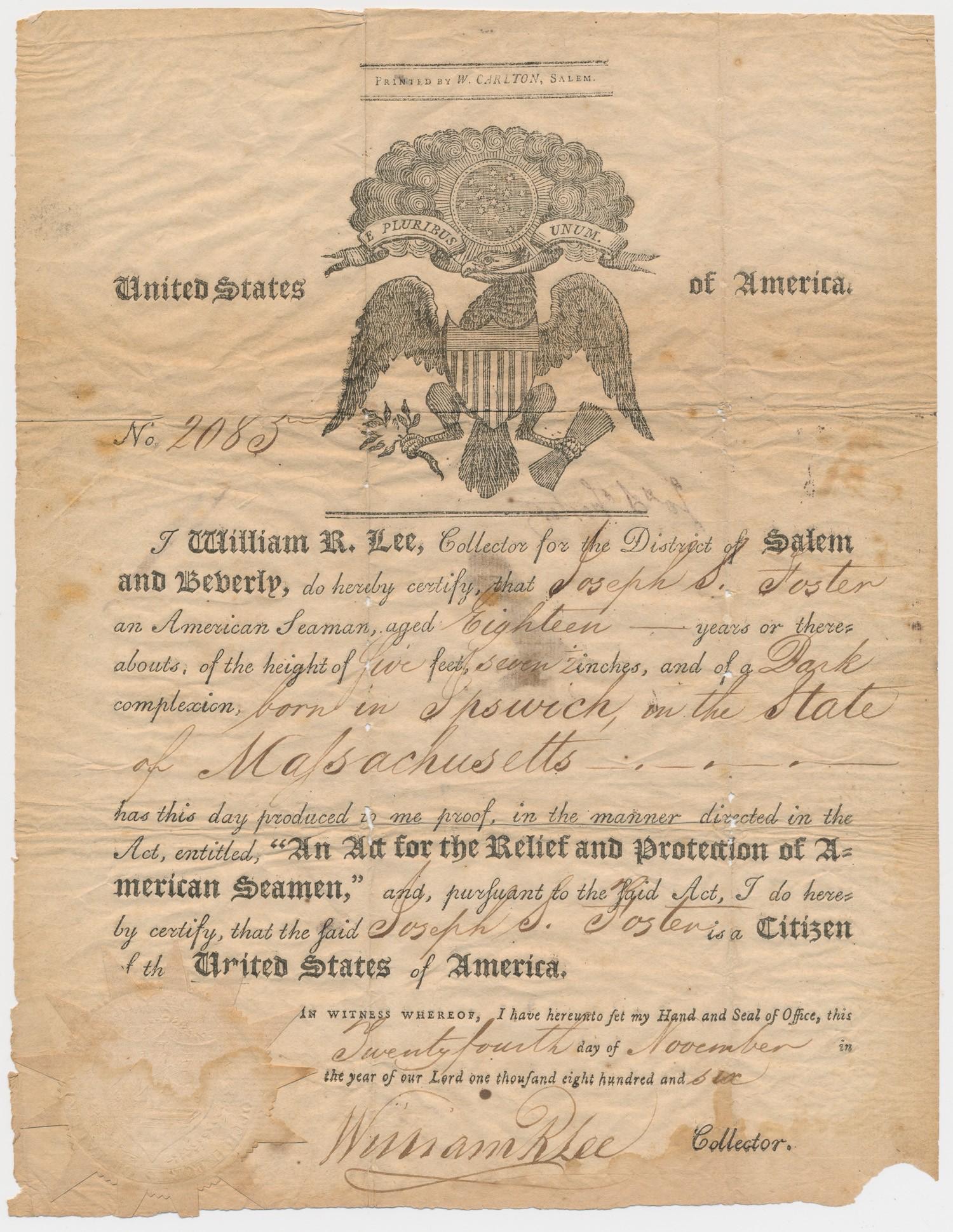
In 1796, the U.S. Congress passed “An Act for the Protection and Relief of American Seaman.” A seaman’s certificate proved a sailor was a U.S. citizen and was intended to protect him from impressment.
Sign Location
More …
Resources
- Brunsman, Denver. “The Knowles Atlantic Impressment Riots of the 1740s,” Early American Studies, Vol 5, No.2, Fall 2007.
- Brunsman, Denver. The Evil Necessity: British Naval Impressment in the Eighteenth-Century Atlantic World, University of Virginia Press, 2024.
- Feld, Jonathan. “Commerce and Conflict: The Knowles Riot of 1747 and Transatlantic Opposition to Impressment,” Penn History Review
- Lax, John and William Pencak. “Knowles Riot and the Crisis of the 1740s in Massachusetts,” Perspectives in American History 10, 1976.
- New England Historical Society. “British Press Gangs Cause the Boston Riot of 1747.”
- Tager, Jack. Boston Riots: Three Centuries of Social Violence, Northeastern University Press, 2000.
Acknowledgments
- Warm thanks to Professor Denver Brunsman, Chair, Dept of History at George Washington University for his remarkable research on impressment and the Knowles Riot and for kindly reviewing our sign.
- Our gratitude to the Perkins School for the Blind Recording Studio and Thomasine Berg for their partnership in creating the audio files.