Black Mariners
in the North End
(awaiting installation)
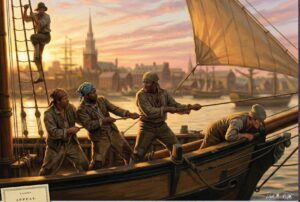
Black mariners spent many years at sea, but men with families often chose to sail on shorter trips along the eastern seaboard. They were highly skilled seamen.
Image by Roberto Mighty
After slavery was gradually abolished in Massachusetts in the 1780s, African Americans struggled to gain an economic foothold. Work on board ships was one of the few opportunities open to Black men. Pay was low but often equal regardless of race. In the early 1800s, about 20 percent of Black men in Boston were mariners.
Beyond serving as crew, Black seamen helped fugitives escape slavery by sea. They also served as a vital news network along the Atlantic seaboard between free people of color and the enslaved.
In 1829, David Walker published his eloquent, fiery Walker’s Appeal in Boston. He called on Black people to abolish slavery and seek racial equality. Seamen smuggled the booklet aboard vessels and distributed it in slave-holding states—where it was quickly banned as seditious. Southern states enforced their Negro Seamen Acts, confining Black mariners to jail while their vessels were in port to prevent contact with enslaved African Americans. These laws together with changing hiring practices reduced the numbers of Black mariners. Many who continued to sail were limited to jobs as cooks or stewards.
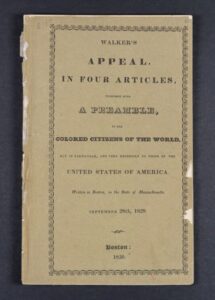
David Walker’s Appeal galvanized the abolitionist movement.
Cover page courtesy of the Massachusetts Historical Society
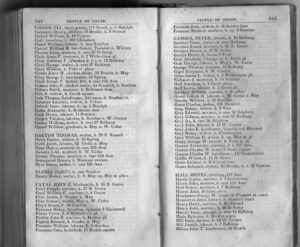
On these two pages from the 1845 Stimpson’s Boston Directory, 20 Black men identify themselves as mariners. The directory of Boston’s residents also shows how people of color were listed separately at the back and how constricted their economic opportunities still were 60 years after slavery ended in Massachusetts.
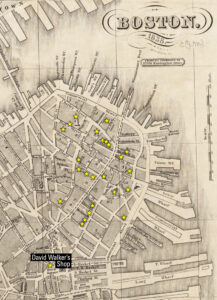
Stars on the 1838 map show the many places in the North End where Black mariners lived from the late 1780s–1840s. Dozens lived in homes or boarding houses on Robinson’s Alley, (now the Paul Revere Mall), Bartlett Street (now Harris Street), and Ann Street (now North Street).
Map detail courtesy of the Norman B. Leventhal Map Center at Boston Public Library
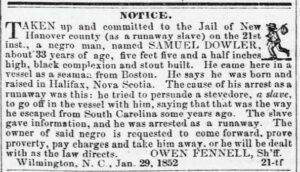
The Library of Congress estimates that between 1730 and 1865, more than 200,000 runaway slave ads were published in newspapers. Black mariners aided freedom-seekers.
Wilmington Journal, January 1852
Sign Location
More …
Resources
- “Africans in America: David Walker,” PBS https://www.pbs.org/wgbh/aia/part4/4p2930.html
- Bolster, W. Jeffrey. Black Jacks: African American Seamen in the Age of Sail. Harvard University Press, 1997.
- Bolster, W. Jeffrey. “To Feel Like a Man: Black Seamen in the Northern States, 1800-1860. The Journal of American History, Vol 76, No. 4, March 1990.
- Brown, Rebecca Warren. Memoir of Mrs. Chloe Spear, a Native of Africa, Who was Enslaved in Childhood, and Died in Boston, January 3, 1815…Aged 65 Years. By a Lady of Boston. Boston: Published by James Loring, 1832.
- Black mariners in the Navy http://www.blackmariners.com/underfireintro.html
- Horton, James Oliver and Lois E. Horton. Black Bostonians: Family Life and Community Struggle in the Antebellum North. Holmes & Meier, revised edition 1999.
- Horton, James Oliver. Free People of Color: Inside the African American Community. Smithsonian Institution Press, 1993.
- “Mapping North End’s Black Community 1780-1810” https://uploads.knightlab.com/storymapjs/9484616cc7063e8750d161d88cf78f23/north-end-map/index.html
- Mighty, Roberto. “We Were Here Too,” Copp’s Hill project — https://wewereheretoo.myportfolio.com/
- Rediker, Marcus. Freedom Ship: The Uncharted History of Escaping Slavery by Sea. Viking, 2025.
- “We Were Here, Too” https://www.robertomighty.com/new-media
Acknowledgments
- Sincere thanks to Ryan Bachmann, PhD and Jeffrey Bolster, PhD for their guidance and expertise.
- Our gratitude to the Perkins School for the Blind and Thomasine Berg for their partnership in creating the audio files.