Navy Yard Features Map
in Charlestown
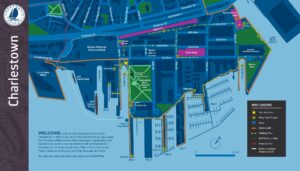
Welcome to what was once the Charlestown Navy Yard. Established in 1800, it was one of the nation’s first six navy yards. For 174 years skilled workers from carpenters, ropemakers, and machinists to welders and electricians built and maintained hundreds of U.S. Navy vessels here. Take a 2-mile walk to see historic features of the navy yard that showcase this work.
We invite you to follow along using the audio tour or read about each feature as you come across it.
Alternatively, if you prefer to choose your own path around the former navy yard, its features are listed alphabetically so you can readily find what you’d like to know more about.
FEATURES ALONG THE TOUR ROUTE–A Self-Guided Walk
Welcome to the former Charlestown Navy Yard. Established in 1800, it was one of the nation’s first six navy yards. For 174 years hundreds of U.S. Navy vessels were built and maintained here. At its peak in the 1940s, during World War 2, the navy yard spread beyond Charlestown into South Boston, East Boston, and Chelsea. The combined navy yard sites employed as many as 50,000 people, including many women. You’ll find lots of additional information about the navy yard on signs along the Harborwalk. This 2-mile walk focuses on historic features still in place around the navy yard— from rail tracks on the ground to a huge saw. They showcase the work that took place here. Let’s begin.
Dry Dock #2
Please turn around so the map sign is behind you to face the narrow body of water leading to the harbor. This used to be the navy yard’s Dry Dock #2. It is where this two-mile walking tour begins and ends.
More than 700 feet long, Dry Dock #2 was built to accommodate the largest ships of the era. It opened for use in 1905. Hundreds of vessels were repaired or constructed here, often two or more at a time.
A vessel would enter when the dock was filled with water. Once it was secured in place, the caisson— a hollow, steel barrier—closed the entrance, creating a water tight seal. Water was pumped out of the dry dock, giving men access to the ship’s hull to make all necessary repairs.
Now look down at the area where you’re standing. Do you see the rail tracks?
Tracks
The tracks run along the perimeter of the former dry dock. All the areas of the navy yard where ship construction or repair took place had tracks like these running along the edges. Notice how far apart the two rails are. Now look across to your right to the tall Portal Crane standing between the buildings. Cranes like that traveled along these tracks.
Portal Crane
Head over and take a closer look. Cranes were used on the piers for heavy lifting during ship construction or renovation. The cranes were also used to load and unload large gear such as cannons and guns.
The crane currently located here along Pier 3 is an example of a portal crane. The open space, or portal, between the metal legs allowed workers and machines to move under the crane instead of having to go around it. Operators drove these cranes along tracks throughout the navy yard.
Walk up Pier 3, toward the harbor, keeping Dry Dock #2 on your left until you reach Building 125.
Marine railway
Building 125 is the former Paint Shop. As you face the building, on its left side you can walk through a gate and around the side of the building. From here at mid- to low tide, you can see remnants of the marine railway that was built in 1919.
How did it work? Smaller naval vessels from tugboats to submarines were floated onto a wood cradle that had rail wheels mounted on rail tracks. Once the vessel was securely in position, the cradle would be pulled out of the water up the rail tracks by a winching system. This marine railway was in use for almost 50 years.
Next, please backtrack along the former dry dock to where you began. Cross 1st Ave and walk up to the Muster House, with its distinctive white cupola, straight ahead on a rise.
Muster House
Completed in 1853, the Muster House is distinctive because of its graceful octagonal design. In the 1800s, navy yard workers gathered here to receive their work assignments and their pay. Civil engineers had offices upstairs. In the late 1890s, mustering no longer took place here. Telephones had been introduced in the navy yard and the ground floor housed the navy yard’s telephone exchange.
From the front of the Muster House turn right to where a path between buildings leads to 2nd Avenue. This segment of 2nd Avenue is a pedestrian-only, quiet way between various navy yard buildings. It will take you to 9th Street, crossing two streets along your way. Directly ahead, on the other side of 9th Street, is part of the immense Chain Forge building.
A side note: The Boston Marine Society
The Boston Marine Society isn’t a part of the navy yard but has an amazing history. In 1742 a group of ship captains formed a Fellowship Club. A dozen years later, the club received a charter from the Royal Governor that directed the group to “make navigation more safe” and to relieve members and their families in poverty or other “adverse accidents in life”—essentially a mutual aid society. The society’s role in safe navigation continues to this day since members have a role in the appointment of the state’s harbor pilots.
You can visit the Society’s headquarters on First Avenue by appointment to see their interesting collection of artifacts, ship models, and paintings.
Chain Forge
The Chain Forge begins at the corner of 9th St and 1st Avenue and stretches up 1st Avenue to 13th St. It is huge. The city of Boston has been working for years to find a developer for the building so it can be converted while retaining some key historic features. You may want to walk up 1st Avenue a ways to get a sense of this building’s size and then return to 9th Street.
More than 20 years before the Chain Forge was built in 1904, the Charlestown Navy Yard had already established itself as the primary manufacturer of anchors and anchor chain for the U.S. Navy.
This building not only housed the chain forge, it also had its own steam boilers and electric power plant. In addition to manufacturing chain, it was the repair facility for the navy yard’s railway locomotives. During its peak years—World War 2, 1939-1945—the Forge had a staff of 550 people working around the clock, including women and African Americans.
In the 1920s, two Chain Forge employees had developed an innovative technique for fabricating steel chains called “die-lock.” This technique produced a nearly indestructible chain. In 1928 it became the new standard for the entire U.S. fleet.
Die-lock chain was formed from two interlocking pieces and required no welding. Instead, one side had a toothed peg, or “stem” and the other had a perfectly sized hole, or “socket.” Using a furnace, workers heated the side with the socket to 2,100 degrees Fahrenheit, allowing the metal to expand just enough for the cool stem to be inserted into the socket. Enormous hammers then dropped several times with immense force to permanently bond the two parts together into a link of chain.
The largest hammer in the Chain Forge building had a force of 12 tons—the weight of a city bus. The hammer sat on its own concrete foundation 35 feet deep to prevent the building from shaking.
When Charlestown Navy Yard closed in 1974, die-lock chain ceased to be manufactured. However, chains forged here are still in use, transferred from decommissioned ships onto new ones.
Return to where you began on 9th Street, facing the Chain Forge building. Go left (west) up 9th Street right up to the incredibly long Ropewalk building. Once at the Ropewalk, consider walking to the left (south) for a stretch to get a sense of this unusual building, then turn around a head north again.
Ropewalk
How long is this long building? Almost a quarter mile, stretching from 5th Street to just shy of 13th Street. Sailing ships, with their complex rigging, required vast quantities of long, sturdy ropes made from twisted hemp fibers. In a traditional ropewalk, workers walked backwards as they twisted hemp fibers into rope. This Ropewalk building was constructed in 1837. It was designed to accommodate pioneering, steam-powered machinery developed by famous local inventor, Daniel Treadwell. Treadwell had developed the first successful machine for spinning hemp into rope several years earlier.
During its long years of operation, the Charlestown Navy Yard ropewalk was the Navy’s only ropewalk, supplying nearly all of its rope. In part this was because Boston was one of the main importers of hemp. Additionally, Boston had a number of commercial ropewalks from which skilled workers could be drawn.
A fun tidbit: For over a century, a walkway, informally known as “Flirtation Walk,” ran parallel to the Ropewalk building. The name apparently came from its use by courting couples.
Leaving the Ropewalk behind your left shoulder, proceed straight ahead (north) over a gravel pathway and then down 5th Avenue to its end at 16th Street. Directly in front is a building with #114 on it; this is the former Woodworking Shop. The lobby is open to the public. Inside, you’ll find interesting information and photographs about the work that took place here.
Proceed out the far door, opposite to where you entered. Straight ahead is the Little Mystic Channel. Immediately to your left stands the Bandsaw.
If the lobby is not open, go around the right side of the building. Look toward the bridge and you’ll see the Bandsaw in back of the building.
Bandsaw
By some accounts, this may be the largest bandsaw in the world. It used to stand in a pit below ground level inside the Woodworking Shop. The saw itself was then accessible on the first floor where all the cutting took place. Here men working the saw transformed raw timber into wood to build boats. This included making the complicated cuts needed to construct frames for a wooden boat.
You are now about half way through the walking tour. You have connected to the Harborwalk once again and will stay on it all the way back to Dry Dock #2 where this walk began. As you face Little Mystic Channel, turn right and walk along this Mystic River inlet.
Timber
As you approach Spaulding Rehabilitation Hospital on the right, note the long segments of old timber on the ground alongside the Harborwalk. A few steps further, you’ll see another similar timber length on the left as well. Several more serve as benches along the front of the hospital.
When construction work began on Spaulding Hospital in 2010, workers found many tons of historic live oak timbers buried on the property. Why? This area was once one of the navy yard’s timber basins. Timber would be submerged, protected by salt water until it was needed for ship repair or construction. As the demand for wooden ships declined, the Navy filled the basin, burying the timber.
Once discovered by construction crews, the timbers found a new purpose around the hospital as informal seating areas. Some timber, however, was used as intended. It was donated to Mystic Seaport Museum and was used in the restoration of the whaling ship Charles W. Morgan.
To extend your walk, you can go to the end of the pier in front of Spaulding Hospital. Or continue along the Harborwalk, keeping the hospital on your right. When you reach the corner of the Harborwalk where Spaulding’s property ends, notice the long narrow body of water stretching toward the harbor. Does it look familiar? It’s the location of another former dry dock—Dry Dock #5.
Dry Dock #5
Like Dry Dock #2 where the walk began, this dry dock was also used for construction, repair, and maintenance of vessels. The basin was filled with sea water to float the vessel in or out, and emptied of water to allow workers access to all exterior parts of the ship.
Dry Dock #5 was constructed in 1941 while World War 2 raged in Europe but before the U. S. had entered the war. The dock was 605 feet long by 518 feet wide, had a height of 26 feet, and could hold water 21 feet deep. Between the time the dock opened and the end of World War 2 in 1945, 54 vessels were constructed in this dry dock. Many more were serviced here.
To continue along the Harborwalk, turn left between the chain link fence and the brick building, keeping Dry Dock #5 on your left. You’ll find many interpretive signs along this stretch of the Harborwalk, each providing more information about the ships that were built here and the skilled work force that made it all happen. When you reach a sign about women working in the navy yard, look beyond it at the exposed wood structures. You can see more or less of the remnants depending on how high the tide is. What is this?
Shipways
These are the two Shipways (or slipways)—sloping wood ramps on which ships were constructed. The Harborwalk will take you around the Shipways so you can see both from different angles. Shipways 1 was built in 1915 and significantly enlarged in 1939. According to the National Park Service, Shipways 1 is considered to be the single most important historical site for shipbuilding in the country. Shipways 2 was added alongside in 1941.
Ship hulls along with other essential structure were built here. Typically, a noteworthy person would “christen” a new ship on the shipway before it was launched by breaking a bottle of champagne across the hull. Then the ship was released, gliding down the ramp and into the harbor. Destroyers, destroyer escorts, dock landing ships, tank landing ships—all slid off these Shipways.
Once the ship was afloat, it tied up alongside one of several navy yard piers, where outfitting was completed. By the time World War 2 ended, workers in the Charlestown Navy Yard had built approximately 300 vessels and serviced another 4,600. The last ship constructed on the shipways was the USS Suffolk County, in 1956. The wide wood ramps stretching into the harbor are all that remain of this productive shipbuilding site.
Continue along the Harborwalk past condominiums to your left and right on land that used to be the navy yard. As you pass Pier 6, where you’ll see a restaurant midway along the pier, notice the Light Tower at the end of the pier. Or walk all the way to the end to see it up close. Another light tower remains at the end of Pier 4 as well.
Light Towers
The light towers on piers 6 and 4 are approximately 60′ high. During the navy yard’s peak production years, the light towers supported banks of incandescent light fixtures, illuminating the entire pier. This made possible around-the-clock work shifts as men constructed, repaired, loaded and unloaded ships.
As you continue along the Harborwalk, you’ll soon find yourself back alongside Dry Dock #2. Two final navy yard features alongside the dry dock deserve attention.
Pump House
The round brick building close to the ferry ramp looks unassuming. That’s because most of the Pump House is 60 feet underground—the structure is as deep as the light towers are tall. The construction of the Pump House was an integral part of the Dry Dock #2 complex and was completed the same year, 1905.
At the base of the Pump House, a duct ran under Dry Dock #2 over to the navy yard’s first dry dock, which is in the National Historical Park. Massive electrical pumps housed on three underground levels of the Pump House served both dry docks. These pumps could fill Dry Dock #2 in one hour and drain it in two. Decades after the navy yard closed, the equipment inside remains in place but not accessible to the public.
Capstan
With your back to the Dry Dock, go about 50 feet to the left (west) of the Pump House. You’ll see one more feature from the navy yard: a capstan mounted on a cement platform. A capstan is a vertical-axled rotating machine that multiplies pulling force. On board sailing ships, sailors raise large heavy sails manually using capstans. Similarly, the ones around the navy yard were originally operated manually.
Beginning in 1905, navy yard capstans were replaced by motorized ones. This one, installed when the dry dock was built, was electric. It enabled men to move enormous loads, like a ship, into and out of the dry dock. Three of the eight capstans that assisted operations at Dry Dock 2 remain in place; the others were removed by the Navy to be used at the Portsmouth Navy Yard.
As you make your way along Dry Dock #2, you will return to where you began this tour.
If you haven’t already done so, we invite you to continue your exploration of the Charlestown Navy Yard at the Boston National Historical Park just steps away. There you can visit the USS Constitution as well as a destroyer, the Cassin Young. Dry Dock #1 is dry, giving you a terrific look at how Dry Dock 2 and 5 once looked. So much to discover. Enjoy! Thank you for joining us.
~~~
NAVY YARD FEATURES IN ALPHABETICAL ORDER
Welcome to the former Charlestown Navy Yard. Established in 1800, it was one of the nation’s first six navy yards. For 174 years hundreds of U.S. Navy vessels were built and maintained here. At its peak in the 1940s, during World War 2, the navy yard spread beyond Charlestown into South Boston, East Boston, and Chelsea. The combined navy yard sites employed as many as 50,000 people, including many women. You’ll find lots of additional information about the navy yard on signs along the Harborwalk. This 2-mile walk focuses on historic features still in place around the navy yard— from rail tracks on the ground to a huge saw. They showcase the work that took place here.
Please note:
- For visitors who prefer to choose their own path around the navy yard, the features are arranged alphabetically.
- If you prefer to follow the tour route, please go to “Features Along the Tour Route” or access the audio tour.
Bandsaw
By some accounts, this may be the largest bandsaw in the world. It used to stand in a pit below ground level inside the Woodworking Shop. The saw itself was then accessible on the first floor where all the cutting took place. Here men working the saw transformed raw timber into wood to build boats. This included making the complicated cuts needed to construct frames for a wooden boat.
Capstan
With your back to the Dry Dock, look about 50 feet to the left of the Pump House. You’ll see a capstan mounted on a cement platform. A capstan is a vertical-axled rotating machine that multiplies pulling force. On board sailing ships, sailors raise large heavy sails manually using capstans. Similarly, the ones around the navy yard were originally operated manually.
Beginning in 1905, navy yard capstans were replaced by motorized ones. This one, installed when the dry dock was built, was electric. It enabled men to move enormous loads, like a ship, into and out of the dry dock. Three of the eight capstans that assisted operations at Dry Dock 2 remain in place; the others were removed by the Navy to be used at the Portsmouth Navy Yard.
Chain Forge
The Chain Forge begins at the corner of 9th St and 1st Avenue and stretches up 1st Avenue to 13th St. It is huge. The city of Boston has been working for years to find a developer for the building so it can be converted while retaining some key historic features. You may want to walk up 1st Avenue a ways to get a sense of this building’s size and then return to 9th Street.
More than 20 years before the Chain Forge was built in 1904, the Charlestown Navy Yard had already established itself as the primary manufacturer of anchors and anchor chain for the U.S. Navy.
This building not only housed the chain forge, it also had its own steam boilers and electric power plant. In addition to manufacturing chain, it was the repair facility for the navy yard’s railway locomotives. During its peak years—World War 2, 1939-1945—the Forge had a staff of 550 people working around the clock, including women and African Americans.
In the 1920s, two Chain Forge employees had developed an innovative technique for fabricating steel chains called “die-lock.” This technique produced a nearly indestructible chain. In 1928 it became the new standard for the entire U.S. fleet.
Die-lock chain was formed from two interlocking pieces and required no welding. Instead, one side had a toothed peg, or “stem” and the other had a perfectly sized hole, or “socket.” Using a furnace, workers heated the side with the socket to 2,100 degrees Fahrenheit, allowing the metal to expand just enough for the cool stem to be inserted into the socket. Enormous hammers then dropped several times with immense force to permanently bond the two parts together into a link of chain.
The largest hammer in the Chain Forge building had a force of 12 tons—the weight of a city bus. The hammer sat on its own concrete foundation 35 feet deep to prevent the building from shaking.
When Charlestown Navy Yard closed in 1974, die-lock chain ceased to be manufactured. However, chains forged here are still in use, transferred from decommissioned ships onto new ones.
Dry Dock #2
Face the narrow body of water between Piers 3 and 4. This used to be the navy yard’s Dry Dock #2.
More than 700 feet long, Dry Dock #2 was built to accommodate the largest ships of the era. It opened for use in 1905. Hundreds of vessels were repaired or constructed here, often two or more at a time.
A vessel would enter when the dock was filled with water. Once it was secured in place, the caisson— a hollow, steel barrier—closed the entrance, creating a water tight seal. Water was pumped out of the dry dock, giving men access to the ship’s hull to make all necessary repairs.
Dry Dock #5
Like Dry Dock #2, this dry dock was also used for construction, repair, and maintenance of vessels. The basin was filled with sea water to float the vessel in or out, and emptied of water to allow workers access to all exterior parts of the ship.
Dry Dock #5 was constructed in 1941 while World War 2 raged in Europe but before the U. S. had entered the war. The dock was 605 feet long by 518 feet wide, had a height of 26 feet, and could hold water 21 feet deep. Between the time the dock opened and the end of World War 2 in 1945, 54 vessels were constructed in this dry dock. Many more were serviced here.
Light Towers
The light towers on piers 6 and 4 are approximately 60′ high. During the navy yard’s peak production years, the light towers supported banks of incandescent light fixtures, illuminating the entire pier. This made possible around-the-clock work shifts as men constructed, repaired, loaded and unloaded ships.
Marine Railway
Building 125 on Pier 3 is the former Paint Shop. As you face the building, on its left side you can walk through a gate and around the side of the building. From here at mid- to low tide, you can see remnants of the marine railway that was built in 1919.
How did it work? Smaller naval vessels from tugboats to submarines were floated onto a wood cradle that had rail wheels mounted on rail tracks. Once the vessel was securely in position, the cradle would be pulled out of the water up the rail tracks by a winching system. This marine railway was in use for almost 50 years.
Muster House
Completed in 1853, the Muster House is distinctive because of its graceful octagonal design and white cupola. In the 1800s, navy yard workers gathered here to receive their work assignments and their pay. Civil engineers had offices upstairs. In the late 1890s, mustering no longer took place here. Telephones had been introduced in the navy yard and the ground floor housed the navy yard’s telephone exchange.
Portal Crane
Head over and take a closer look. Cranes were used on the piers for heavy lifting during ship construction or renovation. The cranes were also used to load and unload large gear such as cannons and guns.
The crane currently located here along Pier 3 is an example of a portal crane. The open space, or portal, between the metal legs allowed workers and machines to move under the crane instead of having to go around it. Operators drove these cranes along tracks throughout the navy yard.
Pump House
The round brick building close to the ferry ramp looks unassuming. That’s because most of the Pump House is 60 feet underground—the structure is as deep as the light towers are tall. The construction of the Pump House was an integral part of the Dry Dock #2 complex and was completed the same year, 1905.
At the base of the Pump House, a duct ran under Dry Dock #2 over to the navy yard’s first dry dock, which is in the National Historical Park. Massive electrical pumps housed on three underground levels of the Pump House served both dry docks. These pumps could fill Dry Dock #2 in one hour and drain it in two. Decades after the navy yard closed, the equipment inside remains in place but not accessible to the public.
Ropewalk
How long is this long building? Almost a quarter mile, stretching from 5th Street to just shy of 13th Street. Sailing ships, with their complex rigging, required vast quantities of long, sturdy ropes made from twisted hemp fibers. In a traditional ropewalk, workers walked backwards as they twisted hemp fibers into rope. This Ropewalk building was constructed in 1837. It was designed to accommodate pioneering, steam-powered machinery developed by famous local inventor, Daniel Treadwell. Treadwell had developed the first successful machine for spinning hemp into rope several years earlier.
During its long years of operation, the Charlestown Navy Yard ropewalk was the Navy’s only ropewalk, supplying nearly all of its rope. In part this was because Boston was one of the main importers of hemp. Additionally, Boston had a number of commercial ropewalks from which skilled workers could be drawn.
A fun tidbit: For over a century, a walkway, informally known as “Flirtation Walk,” ran parallel to the Ropewalk building. The name apparently came from its use by courting couples.
Shipways
These are the two Shipways (or slipways)—sloping wood ramps on which ships were constructed. The Harborwalk will take you around the Shipways so you can see both from different angles. Shipways 1 was built in 1915 and significantly enlarged in 1939. According to the National Park Service, Shipways 1 is considered to be the single most important historical site for shipbuilding in the country. Shipways 2 was added alongside in 1941.
Ship hulls along with other essential structure were built here. Typically, a noteworthy person would “christen” a new ship on the shipway before it was launched by breaking a bottle of champagne across the hull. Then the ship was released, gliding down the ramp and into the harbor. Destroyers, destroyer escorts, dock landing ships, tank landing ships—all slid off these Shipways.
Once the ship was afloat, it tied up alongside one of several navy yard piers, where outfitting was completed. By the time World War 2 ended, workers in the Charlestown Navy Yard had built approximately 300 vessels and serviced another 4,600. The last ship constructed on the shipways was the USS Suffolk County, in 1956. The wide wood ramps stretching into the harbor are all that remain of this productive shipbuilding site.
Timber
As you approach Spaulding Rehabilitation Hospital on the right, note the long segments of old timber on the ground alongside the Harborwalk. A few steps further, you’ll see another similar timber length on the left as well. Several more serve as benches along the front of the hospital.
When construction work began on Spaulding Hospital in 2010, workers found many tons of historic live oak timbers buried on the property. Why? This area was once one of the navy yard’s timber basins. Timber would be submerged, protected by salt water until it was needed for ship repair or construction. As the demand for wooden ships declined, the Navy filled the basin, burying the timber.
Once discovered by construction crews, the timbers found a new purpose around the hospital as informal seating areas. Some timber, however, was used as intended. It was donated to Mystic Seaport Museum and was used in the restoration of the whaling ship Charles W. Morgan.
Tracks
Rail tracks run along the perimeter of the former Dry Dock #2. All the areas of the navy yard where ship construction or repair took place had tracks like these running along the edges. Notice how far apart the two rails are. The tall Portal Crane standing between the buildings near Pier 3 traveled along these tracks.
If you haven’t already done so, we invite you to continue your exploration of the Charlestown Navy Yard at the Boston National Historical Park just steps away. There you can visit the USS Constitution as well as a destroyer, the Cassin Young. Dry Dock #1 is dry, giving you a terrific look at how Dry Dock 2 and 5 once looked. So much to discover. Enjoy! Thank you for joining us.
~~~
Sign Location
More …
Resources
Acknowledgments
- Warm thanks to NPS historian Steve Carlson for his steadfast support and careful review of the tour content. We are also grateful to additional staff members who helped guide the development of the walking tour script.
- Our gratitude to the Perkins School for the Blind and Thomasina Beck for their partnership in creating the audio files.