Preserve and Extend Knowledge
in Dorchester
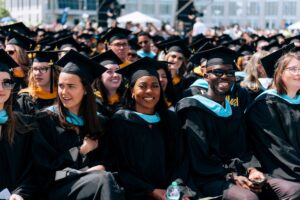
In September 1965, 1,227 students began classes at the new University of Massachusetts Boston in downtown. A confluence of factors led to its creation. In the midst of social activism and during the Civil Rights Movement, public universities across the country recognized the need for urban public campuses. “There ought to be a place… where city kids will trip over opportunity for higher education,” said Massachusetts House Speaker Robert Quinn.
“From the start, UMass Boston’s aim was to give all its students—regardless of age, prior schooling, or background—a full chance to compete with the graduates of the best private institutions in Massachusetts,” said Paul Gagnon, the first Dean of Faculty. His vision attracted an exceptional faculty excited by the unique opportunity to build an institution.
Approximately 16,000 students attend UMass Boston. Over the years, the university has acquired new neighbors, grown, and changed dramatically, but “its teaching soul and service conscience continue to shape the university’s character,” wrote historian Michael Feldberg.
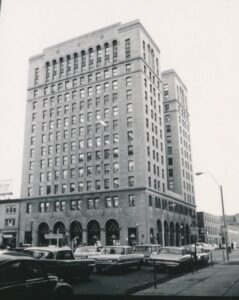
When it opened in 1965, UMass Boston’s temporary home was in the former Boston Consolidated Gas building on Arlington Street.
Courtesy of University of Massachusetts Boston Archives
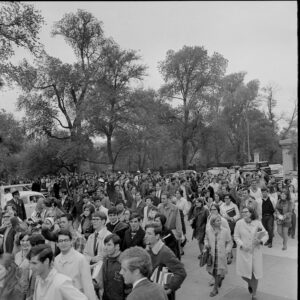
UMass Boston students and faculty rallied on Boston Common and at the State House protesting the future location of a permanent campus. They felt Columbia Point was too far from the heart of the city.
1967 photo courtesy of Boston Public Library
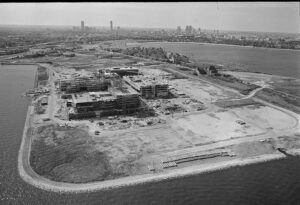
Columbia Point was once a cow pasture and then a landfill. The establishment of UMass Boston’s campus on Columbia Point in 1974 led to significant additional investment and develop-ment on the Point, including the John F. Kennedy Presidential Library and Museum.
1972 photo by Grant Spencer
“It was right here, right in these waters, where the American experiment began. … It’s your turn to help keep this notion of America alive, that no matter where you were born, what your parents have … you can still rise to become whatever you want and still go on to achieve great things.” Then Senator Barack Obama’s address to the Class of 2006
By the Numbers:
200+ undergraduate, graduate, and certificate programs
130 countries in which students have roots
70+ languages spoken in their homes
The majority from greater Boston
Nearly 60% the first in their family to get a college degree
Sign Location
More …
Resources
- Feldberg, Michael. UMass Boston at 50–A Fiftieth Anniversary History of the University of Massachusetts Boston. University of Massachusetts Press, 2015.
- Forman, Ian. “Infant UMass-Boston Already Quite a Lad,” The Boston Sunday Globe, May 9, 1965.
- Forman, Ian. “1947 Baby Boom Hits Colleges,” The Boston Globe, March 29, 1965.
- Forman, Ian. “A Model Campus in Amherst—What Can Hub Area Expect?” The Boston Globe, June 18, 1964.
- Interviews with eleven founding faculty members, part of Linda Eisenmann UMass Boston Oral History Project Records, 1998. University of Massachusetts Boston Archives.
- Lederle, John W. “Even Greater Expansion Needed,” The Boston Globe, February 2, 1964.
- Sieber, Tim. “Owning Our Past: Learning from the Turbulent History of UMass Boston and Columbia Point,” Faculty Staff Union, August 22, 2019.
- “University of Massachusetts Boston 35th Anniversary Celebration,” April 10, 1999.
Acknowledgments
- Friends of the Boston Harborwalk is deeply grateful to the George B. Henderson Foundation for funding the design, manufacture and installation of the signs at Columbia Point.
- Our gratitude to the Perkins School for the Blind Recording Studio and Thomasine Berg for their partnership in creating the audio files.