Harbor Access for All
in Charlestown
(awaiting installation)
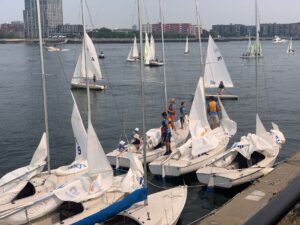
“[Sailing] teaches responsibility, self-reliance, confidence in learned skills, incentive to do better, the ability to work together, and an appreciation of the beauty, indeed the forces, of nature.” Courageous Sailing Center founder Harry McDonough
Photo by Liz Nelson Weaver
Named for two-time America’s Cup winner, Courageous, the Courageous Sailing Center was established in 1987 by Harry McDonough as a place where any child can learn to sail. Thousands have benefited from the center’s programs. Adults, too, can learn to sail here. Members take boats out for the day or weekend. And they can race, including in the winter frostbite program—for the brave. People with developmental disabilities have sailed here with volunteer partners weekly since 1990.
The heart of Courageous Sailing continues to be offering children the opportunity to thrive, especially those from underserved communities. Learning how to tack and when to pull in the jib are the easier skills to master. Working cooperatively with other crew members, managing stressful situations, and trusting your judgment are among the less tangible but vital social-emotional skills kids develop. Courageous Sailing also partners with Boston Public Schools to offer “Swim Sail Science,” which combines sailing with academics. Free transportation and meals, supportive social workers, and dedicated instructors—most of whom learned to sail here—help ensure every child can flourish.
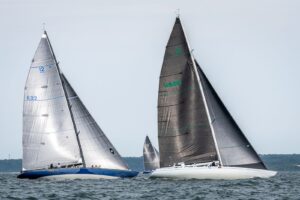
Courageous (right) won the America’s Cup in 1974 and 1977, one of only three yachts to win the prestigious cup twice. Gifted to the City of Boston in 1987, it was docked at Pier 4 for several years—the Sailing Center’s centerpiece. A decade later, Courageous Sailing Center donated the yacht to the Newport Yachting Museum where it was renovated. The yacht now races in Newport, RI.
Photo courtesy of Tyler Fields
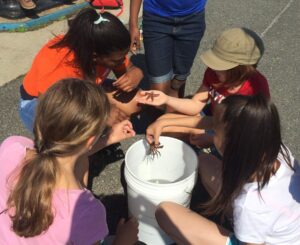
“Swim Sail Science,” a free five-week program, combines academics, enrichment, and sailing and swimming lessons.
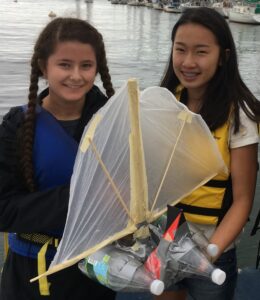
The “trash boat” activity calls on kids to work together to build and test stable, fast, stylish boats using recycled materials.
Photos courtesy of Courageous Sailing Center
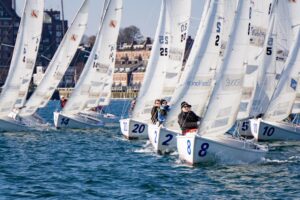
Frostbite sailing—from November through March—is a popular adult racing program at the sailing center.
Photo courtesy of Courageous Sailing Center
Sign Location
More …
Resources
- Chamberlain, Tony. “Warm Welcome for Courageous,” Boston Globe, June 18, 1987.
- Chamberlain, Tony. “A Courageous Mission,” Boston Globe, Sunday, August 23, 1987.Chamberlain, Tony. “Courageous keeps dreams afloat,” Boston Globe, June 14, 1988.
- Chamberlain, Tony. “He Kept the Quest Afloat,” Boston Globe, October 14, 1990.
- “Program gives blind sailor a chance to enjoy the sea,” Boston Globe, August 14, 1994.
- “Close to the Wind and Water,” Boston Globe, April 22, 1995.
- “Maiden Voyages,” Boston Globe, May 31, 1996.
- Murphy, Dan. “Courageous kids learn to sail,” The Charlestown Bridge, October 27, 2004.
- Courageous Sailing Center website
- Interviews with sailors and staff at Courageous Sailing Center, August 2025.
Acknowledgments
- Our gratitude to the Perkins School for the Blind and Thomasine Berg for their partnership in creating the audio files.