Boston’s Italian Fishermen
in the North End
(awaiting installation)
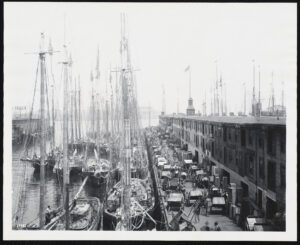
Fishing schooners vie for space while offloading their catch at T Wharf. Fish wholesalers occupied many of the wharf-level stores of the three-story building along with merchants who provisioned ships and sold salt and ice for preserving fish. The lofts above allowed for storing and repairing sails.
1907 photo by Nathaniel L. Stebbins, courtesy of Historic New England
The open water here was once the site of T Wharf. Built in 1718, it became Boston’s fish pier in 1882. Fishermen from Sicily started coming to Boston in the late 1890s in search of work. At T Wharf, some rented 22-foot dories and rowed them 15 to 20 miles each day to catch whitefish, haddock and flounder. Others signed on to ocean-going fishing vessels berthed here to make seven- to ten-day trips out to Georges Bank for cod and other groundfish.
Long dominated by New Englanders, the local fishing industry was strengthened and Boston culturally enriched by these new arrivals. They settled in the North End where other Italians were already living. “Around Fleet, North, Clark and Lewis Streets,” recalls the son of one immigrant, “nearly everyone was from Sciacca,” a fishing center on Sicily’s south coast.
In 1915, most of the fishing industry moved to the newly-constructed Boston Fish Pier in South Boston. Some Sicilians, however, remained at T Wharf until it was demolished in the 1960s.
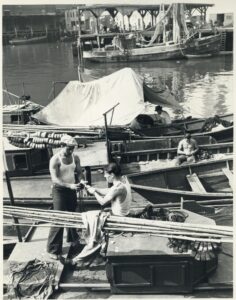
Fishermen tying a float on a net at T Wharf. By the 1940s, many fishermen had boats with engines, but some still used sails which they would dry by draping them over the boom.
Photo courtesy of Boston City Archives
“Fishermen who frequented my grandfather’s tavern used to give us haddock every day, so much of it that we were sick of it as kids, and my grandmother sometimes gave up and fed it to the stray cats.” Jessica Dello Russo
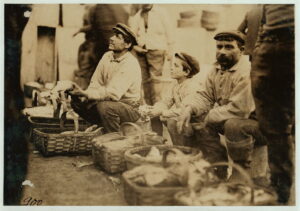
In 1909, photographer and social reformer Lewis Hine took this photo on T Wharf while documenting children having to work. For Boston’s immigrant fishermen, the struggle to make a living was a family affair. They sold their catch as soon as they got back to port.
Photo courtesy of Library of Congress
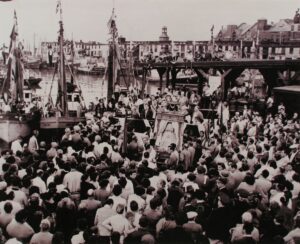
Sicilian fishermen brought with them the Feast of the Madonna del Soccorso, still celebrated here every year around August 15. Note T Wharf in the background. It was demolished as part of the waterfront urban renewal a few years after this photo was taken.
Photo courtesy of the Fishermen’s Club
Sign Location
More …
Resources
- Bunting, W.H. Portrait of a Port: Boston, 1852-1914. Cambridge, MA: Belknap Press, Harvard University Press, 1971.
- German, Andrew W. Down on T Wharf, Mystic Seaport Museum, 1982.
- Hauch, Z. William. T Wharf Notes and Sketches, Alden-Hauck Press, 1952.
- Smith, Dana. Boston Mass, Vintage, Facebook Group, 2024.
- Interview with Andrew Cardinale and Salvator Diecidue, 1 December 2025.
Acknowledgments
- Warm thanks to Andrew Cardinale, Salvatore Diecidue, and members of the Madonna del Socorrso /Fisherman’s Feast Society as well as Jessica Dello Russo for sharing stories of the lives of Italian fishermen living in the North End.
- Our gratitude to the Perkins School for the Blind and Thomasine Berg for their partnership in creating the audio files.