Environmental Injustice
in Dorchester
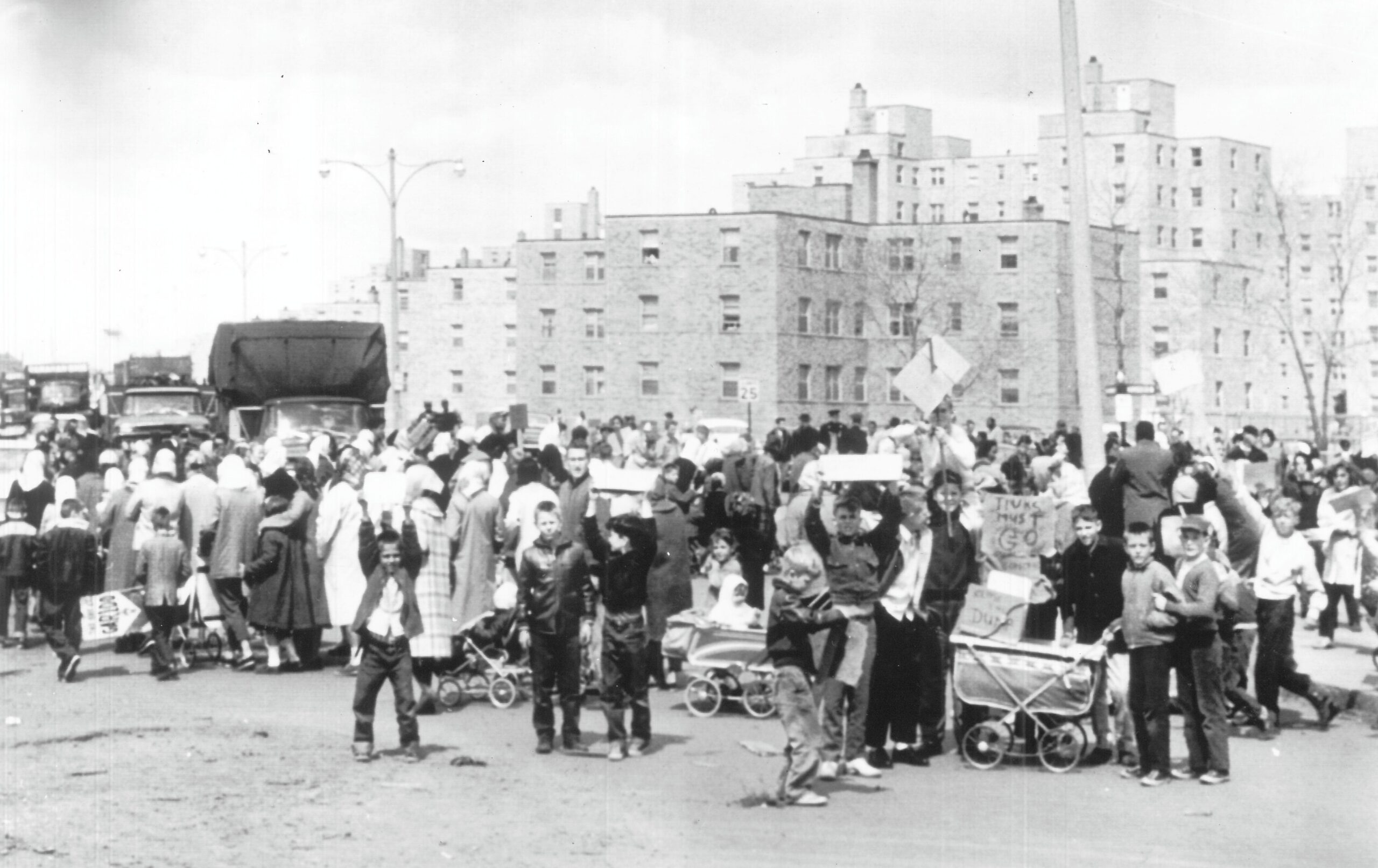
The day after the fatal accident, Columbia Point residents formed a human barricade on Mile Road (also known as Mt. Vernon Street), preventing dump trucks from passing. They picketed City Hall and the State House. They wrote letters to elected officials.
AP Photo
Columbia Point Housing Project opened in 1954. Its closest neighbors were two dumps—one city-owned, the other private—spread across 97 acres of the peninsula. Every day more than 200 dump trucks barreled past the housing project. Rats from the dump snuck into homes. Refuse burned nightly, spewing hazardous smoke.
A “Mothers Club” that had been planning community activities formed the Columbia Point Improvement Association. They began to advocate on behalf of the project’s 1,500 families. The isolated community needed bus service, a grocery store, a school, a church. And the dumps must be closed!
When a dump truck killed a little girl close to her home on April 25, 1962, the mothers erupted in protest. The state legislature passed a law closing both dumps. The city complied; the privately-owned dump sued. Finally, a Supreme Judicial Court ruling forced its closure in February 1963.
“A promise made 14 years ago to close the dumps has at last been fulfilled,” said the Reverend Francis Gilday, rector of Boston College High School on Columbia Point.
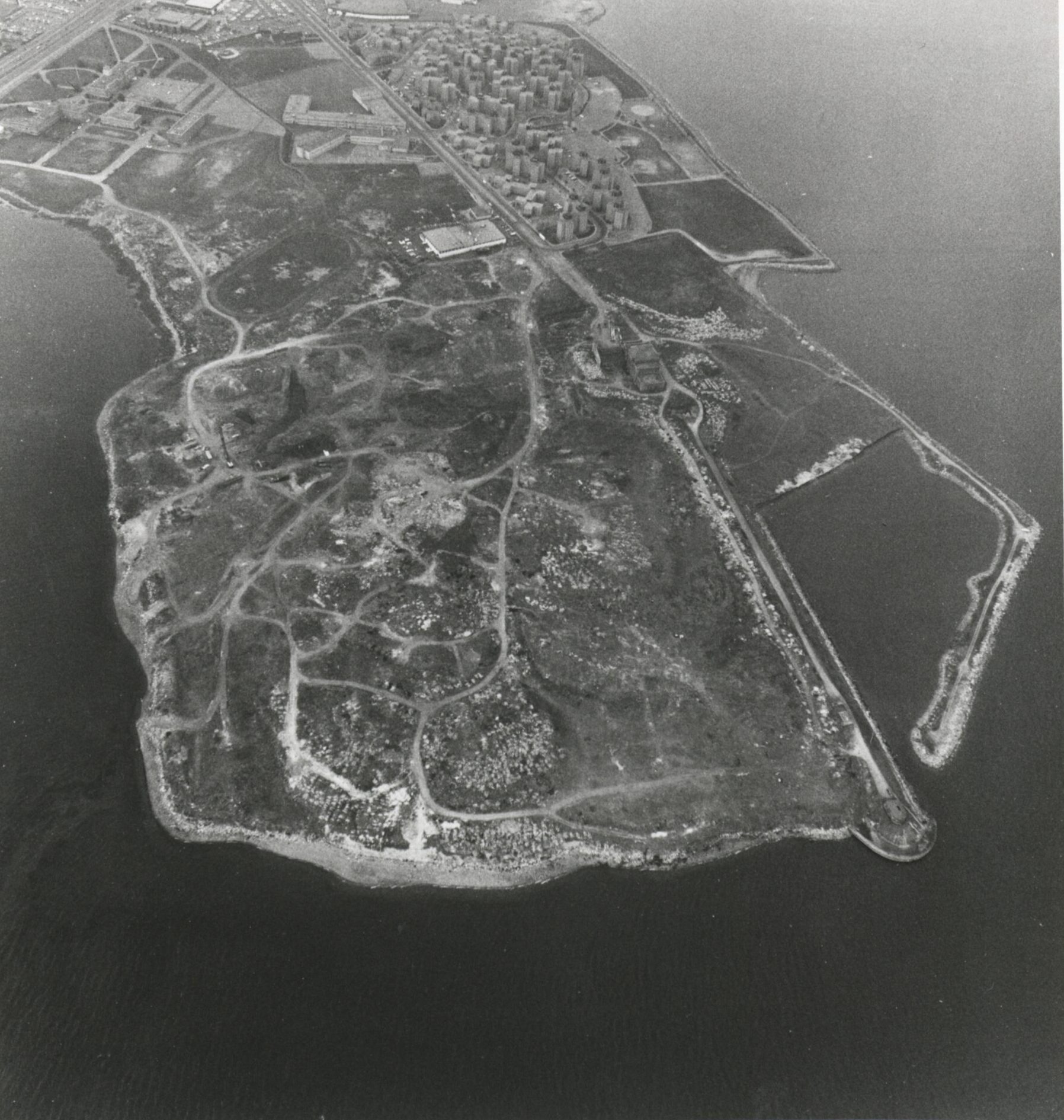
The 1966 aerial photo of Columbia Point shows the closed dumps, an area designated by the city as “blighted.” What was for centuries saltmarsh had been filled with trash. In some places, it was 30 feet high.
University of Massachusetts Boston, University Archives & Special Collections
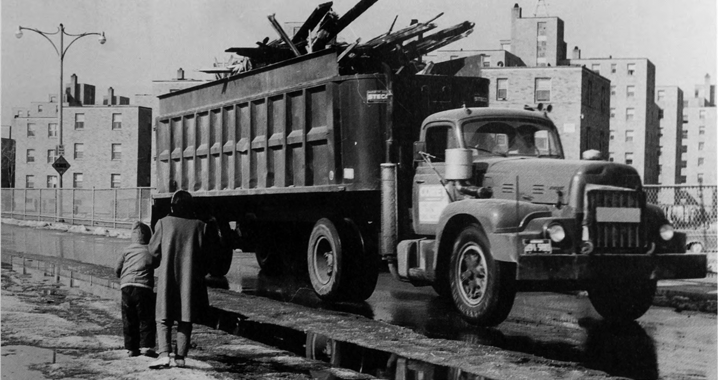
When Columbia Point housing opened to residents, urban renewal was in full swing in Boston. Contractors insisted Mile Road dump was the only option in the Boston area where they could dump demolition debris.
Photo courtesy of The Boston Globe
“Rubbish disposal…must be discontinued immediately and the present dump area must be cleaned up before the new housing is occupied.”
A recommendation by the [Boston] City Planning Board, September 22, 1953, months before the housing project opened.
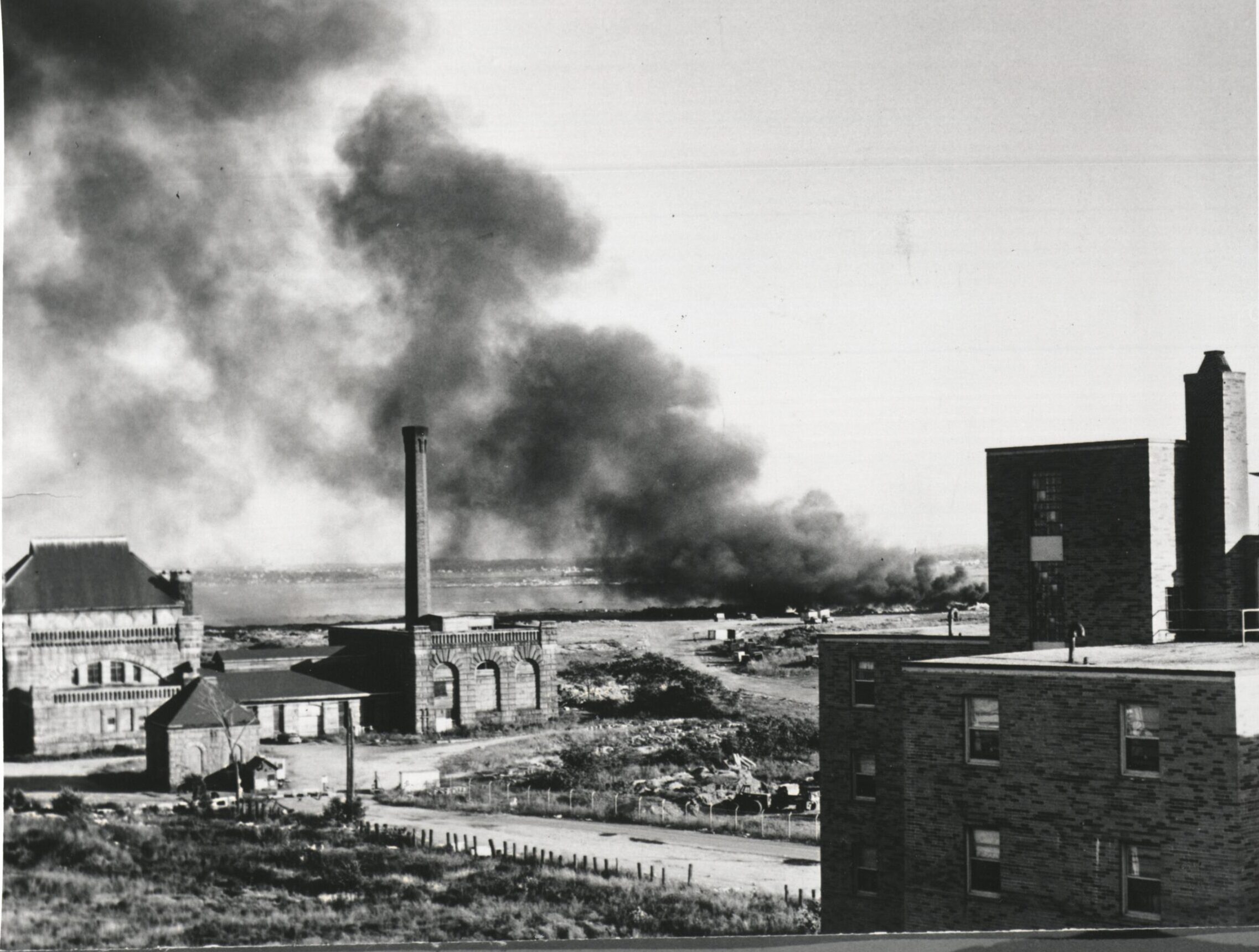
Dump fires continued to burn while courts considered the owner’s suit. The dump owner repeatedly disregarded directives to limit burning to specific wind conditions.
Photo taken from the housing project, The Boston Globe, November 23, 1962
Sign Location
More …
Resources
- The Boston Globe and Boston Herald articles in chronological order
- “Mothers Plan Dump March in Dorchester,” Boston Herald, April 25, 1962.
- “Dump Truce is Reached,” Boston Herald, April 27, 1962.
- “Blaze at Mile Road Dump Spotted 50 miles away,” The Boston Globe, May 16, 1962.
- “Volpe Signs Dump Closing,” The Boston Globe, June 20, 1962.
- “Columbia Point Dumping Stopped; Law Muddled,” The Boston Globe, July 19, 1962.
- “Mothers March Again as Dump Trucks Roll In,” The Boston Globe, July 24, 1962.
- Hurt, Richard L. “Columbia Point—6000 Isolated on ‘Island’—in Heart of Hub,” six-part series, The Boston Globe, September 9-16, 1962.
- Doyle, James S. “City, State Apathy in Curbing Dump Smoke Pollution Flayed,” The Boston Globe, November 23, 1962.
- “State Suit Asks Garbage Ban at Mile Road Dump,” The Boston Globe, November 29, 1962.
- “Dump Row Explodes Anew,” The Boston Globe, February 11, 1963.
- A Decent Place to Live: From Columbia Point to Harbor Point Records, 1951-2000. Interviews and Oral Histories. University of Massachusetts Boston, University Archives & Special Collections.
- Boston College, “The Columbia Point Housing Project, 1954-1986” https://dhprojects.bc.edu/s/20th/page/columbia-point-boston Accessed October 21, 2025
- Kennedy, Marie; Charlotte Ryan, and Jeanne Winner, “The Best Laid Plans…The Early History of Boston’s Columbia Point Public Housing,” for the Columbia Point Oral History Project, Center for Community Planning, College of Public and Community Service, UMass Boston, 1987.
- “Proposal Plan for Future Development of the Calf Pasture Area in the Dorchester District,” The City Planning Board, September 22, 1953.
- Roessner, Jane. A Decent Place to Live: From Columbia Point to Harbor Point—A Community History. Northeastern University Press, 2019.
- Seasholes, Nancy. Gaining Ground: A History of Landmaking in Boston. The MIT Press, 2003.
Acknowledgments
- Friends of the Boston Harborwalk is deeply grateful to the George B. Henderson Foundation for funding the design, manufacture and installation of the signs at Columbia Point.
- Our gratitude to the Perkins School for the Blind Recording Studio and Thomasine Berg for their partnership in creating the audio files.
- Warm thanks to Jane Roessner for all her extensive research that went into her book and her support of our work.