
Calf Pasture Pumping Station
in Dorchester
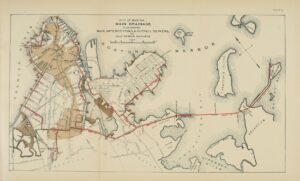
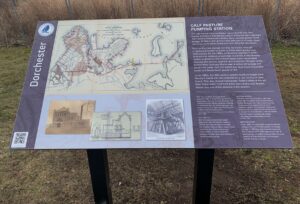
The new Main Drainage Works opened in 1884. It included laying miles of large pipes in the city, building the huge Calf Pasture Pumping Station, dredging a channel in Dorchester Bay, and laying a sewage pipe across the bay over Squantum Point and out to Moon Island’s holding tanks.
Eliot Clarke’s Main Drainage Works of the City of Boston plate V, 1888
The Calf Pasture Pumping Station (up on the hill) was a key feature of Boston’s first sewage system. it was the city’s signature 19th-century infrastructure project. Here, colossal pumps raised sewage 35 feet so that gravity could then carry it through pipes, two miles out to Moon Island and from there into the harbor.
Prior to this, raw sewage ran into the harbor through a haphazard system of pipes or down open gutters that lined streets. By the 1860s, as Boston’s population grew dramatically, epidemics had killed hundreds. It was already widely understood that contaminated water transmitted diseases like cholera, typhoid, and dysentery. The goal of the Boston Main Drainage Works was to collect all sewage and direct it far away from the waterfront, thus improving public health and Bostonians’ quality of life.
In the 1960s, the 19th-century system could no longer meet the city’s needs and was replaced by a new facility on Deer Island. This, too, proved inadequate. Today’s state-of-the-art Deer Island water treatment plant has transformed Boston Harbor into one of the cleanest in the country.
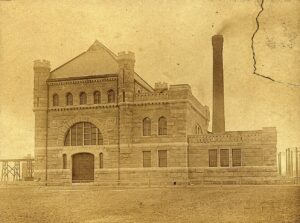
Built to house extraordinarily heavy equipment, the Calf Pasture Pumping Station was also designed to impress. City Architect George Albert Clough chose the Richardson Romanesque style, characterized by heavy castle-like construction with large stone blocks and round masonry arches.
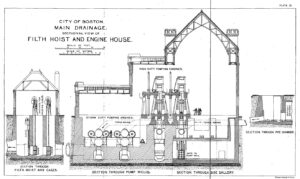
The Pumping Station included a filth hoist which removed debris, such as tree limbs or animal carcasses, that might clog the pumps. For decades the pumps and hoist ran on coal-driven steam. This required a large work force, as well as a wharf on the peninsula and a rail spur for coal deliveries. In the mid 1920s electricity began powering the pumps.
Eliot Clarke’s Main Drainage Works of the City of Boston, 1888
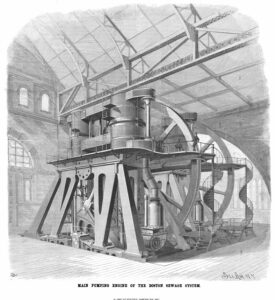
In the 1880s, the two Leavitt pumps handled an average of almost 37 million gallons of sewage per day. In 1905 they were replaced by pumps with a capacity of 70 million gallons per day. At each juncture, the station’s pumps were the most powerful of their kind built up to that point.
Scientific American, no.28, 1887
Sign Location
More …
Resources
- Boston City Planning Board, Proposed Plan for Future Development of the Calf Pasture Area in the Dorchester District, September 22, 1953.
- Clarke, Eliot C. Main Drainage Works of the City of Boston. Boston: Rockwell & Churchill, 1888.
- Frontiero, Wendy. “Calf Pasture Pumping Station: Boston Landmarks Commission Study Report
- (Draft), Petition #263.18.” Boston Landmarks Commission, Office of Historic Preservation, City of Boston (April 2, 2024).
- “‘Massachusetts SP Calf Pasture Pumping Station Complex’ Registration Form.” National Register of
- Historic Places and National Historic Landmarks Program Records (June 18, 1990). https://catalog.archives.gov/id/6379686
- Seasholes, Nancy S. Gaining Ground: A History of Landmaking in Boston. Cambridge, MA: MITPress, 2003.
- U.S. Department of the Interior, National Park Service, “Calf Pasture Pumping Station, Boston, Massachusetts,” National Register of Historic Places
Acknowledgments
- Friends of the Boston Harborwalk is deeply grateful to the George B. Henderson Foundation for funding the design, manufacture and installation of the signs at Columbia Point.
- Our gratitude to the Perkins School for the Blind and Thomasine Berg for their partnership in creating the audio files.
- Our thanks to University of Massachusetts, Boston Professor Nicholas Juravich for his expertise and wonderful support.