Boston Harbor Islands
in Dorchester
For thousands of years this region has been home to Indigenous people. The Massachusett Tribe lived, worked, and held ceremony seasonally on all the harbor islands. In the 1600s, colonists appropriated the islands to graze livestock, harvest trees, and as sites for defensive installations. Bostonians soon saw the islands as locations for institutions and facilities that they did not want in the city. In the 1990s the islands were designated the Boston Harbor Islands National and State Park and are now mostly valued for their distinctive ecology and history. The Massachusett continue to hold the islands sacred.
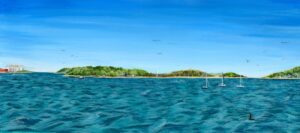
Painting by Rafaela Astudillo
From left to right, the painting depicts three Boston Harbor islands visible from Columbia Point.
Deer Island In the winter of 1675 during Metacomet’s Rebellion (King Philip’s War), hundreds of non-combatant Native people were forcibly removed from Praying Towns and held prisoner on Deer Island without food or shelter. More than half of them perished. Descendants from Tribal communities return each fall to honor those who died there.
In the 1840s, thousands of Irish immigrants with infectious diseases were quarantined on the island. Many never made it to the mainland.
Despite this legacy, the region’s wastewater treatment plant was built on the island. It processes wastewater from two million people living in 43 Greater Boston communities.
Spectacle Island has undergone multiple dramatic changes. From a Native summer habitation prior to colonization, to housing a quarantine hospital, a rendering plant processing hundreds of horse carcasses a year, and a dumping ground for much of Boston’s trash, to its current place as a gem of Boston Harbor.
Spectacle Island’s turnaround began when 3.5 million cubic yards of soil from Boston’s Big Dig project was used to cap the dump. In 2006, the transformed island with five miles of trails, and planted with trees, shrubs, and native grasses welcomed the public.
Directly across the bay, Thompson Island is one of the largest of the harbor islands and most ecologically diverse. It includes sandy and rocky beaches, freshwater wetlands, salt marshes, meadows, and woods. This diversity allowed Native people to thrive on the island for millennia.
In 1626, the Massachusett established a brief trading relationship on the island with an early settler, David Thompson. Two centuries later, the Boston Farm School was founded on the island, to educate the city’s most at-risk boys. Today’s Cathleen Stone Island Outward Bound School in many ways continues the Farm School’s century-long efforts to empower young people
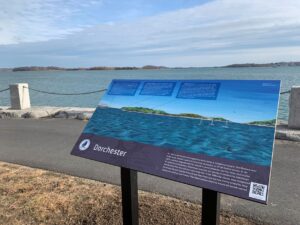
Sign Location
More …
Resources
- Thompson Island/Cathleen Stone Island https://cathleenstoneisland.org/about/our-history
- “Deer Island,” https://www.nps.gov/places/deer-island.htm
- Kales, Emily and David. All About the Boston Harbor Islands, Hewitts Cove Publishing Co, Inc., 1983.
- Mikal, Alan. Exploring Boston Harbor, The Christopher Publishing House, 1975.
- Massachusett Tribe at Ponkapoag https://massachusetttribe.org/
- Morss, Jr., Sherman. Boston Harbor Islands, Commonwealth Editions, 2005.
- Simková, Pavla. Urban Archipelago, An Environmental History of the Boston Harbor Islands, University of Massachusetts Press, 2021.UMass Boston has Thompson Island materials in its special collection. https://archives.umb.edu/repositories/2/resources/234
Acknowledgments
- Friends of the Boston Harborwalk is deeply grateful to the George B. Henderson Foundation for funding the design, manufacture and installation of the signs at Columbia Point.
- We are indebted to the late Suzanne Gall Marsh, founder of Friends of the Boston Harbor Islands and a lifelong advocate for the islands. Suzanne kindly contributed her expertise and was a warm supporter of our work.